Author

Croatia → Montenegro → Bosnia & Herzegovina – Our 13-Day Balkan Road Trip
August 5, 2026
Three countries. Thirteen days.
From Dubrovnik’s Walls to Lukomir’s Heights: June –July, 2026
Four UNESCO World Heritage Sites. One secret nuclear bunker. A freezing cave, a wild river, a mountain village reached by ATV, an Iron Throne visited in shorts—and enough football to turn every evening into a mini World Cup party.
Our route began beside the blue Adriatic in Dubrovnik, climbed into Montenegro’s rugged mountains, crossed into the cultural mosaic of Bosnia & Herzegovina, and finally curved back to the Croatian coast. It was not a “tick-the-box” holiday. We climbed, hiked, rafted, drove through tunnels cut into rock, got lost on an Olympic mountain and ate dinner in one of Bosnia’s most isolated villages.
This was the Balkans at full volume—and we loved it.
Our 13-day itinerary at a glance
| Day | Date | Main experiences | Overnight |
|---|---|---|---|
| 1 | Jun 25 | Mount Srđ, Stradun, Old Town and Old Port | Villa Sigurata, Dubrovnik |
| 2 | Jun 26 | Cathedral, Sponza memorial, market, Lokrum and Fort Lovrijenac | Villa Sigurata |
| 3 | Jun 27 | Dubrovnik City Walls and Rector’s Palace | Villa Sigurata |
| 4 | Jun 28 | Drive to Kotor; waterfront and walled Old Town | MonteBay Perla, Prčanj/Kotor |
| 5 | Jun 29 | Kotor Fortress, Kotor Serpentine, Lipa Cave and Nikšić | Hotel SKI, Žabljak |
| 6 | Jun 30 | Black Lake hike and Tara Canyon | Hotel SKI |
| 7 | Jul 1 | Tara River rafting | Hotel SKI |
| 8 | Jul 2 | Piva Lake road trip and Sarajevo Old Town | Hotel Aziza, Sarajevo |
| 9 | Jul 3 | Olympic bobsleigh track and ATV ride to Lukomir | Hotel Aziza |
| 10 | Jul 4 | Tito’s Bunker and Konjic | Hotel Aziza |
| 11 | Jul 5 | Sarajevo to Mostar; Old Bridge and bazaar | Muslibegović House, Mostar |
| 12 | Jul 6 | Heritage-house tour, mosque minaret, Počitelj and Plat | Hotel Villas Plat |
| 13 | Jul 7 | Adriatic breakfast, rental-car return and flight home | — |
Day 1 — Dubrovnik from the sky to the stones
We began high above Dubrovnik on Mount Srđ. The cable car costs €30 return for an adult and officially takes just 3 minutes 30 seconds to travel 778 metres to the upper station, 405 metres above sea level. For the best Old Town video while going up, stand at the downhill-facing rear window.
Our timing was 5:00–8:00 p.m., but my advice is to go up around 6:30–7:00 p.m. and stay through sunset and the city lights. The official summer programme begins its live music after 6:30 p.m., and the atmosphere becomes much better as the day-trippers leave.

From Mount Srđ, Dubrovnik looks like a story written in stone, sea and sunlight.
Back below, we walked through the Old Town, along the Old Port and onto Stradun, Dubrovnik’s polished limestone main street.
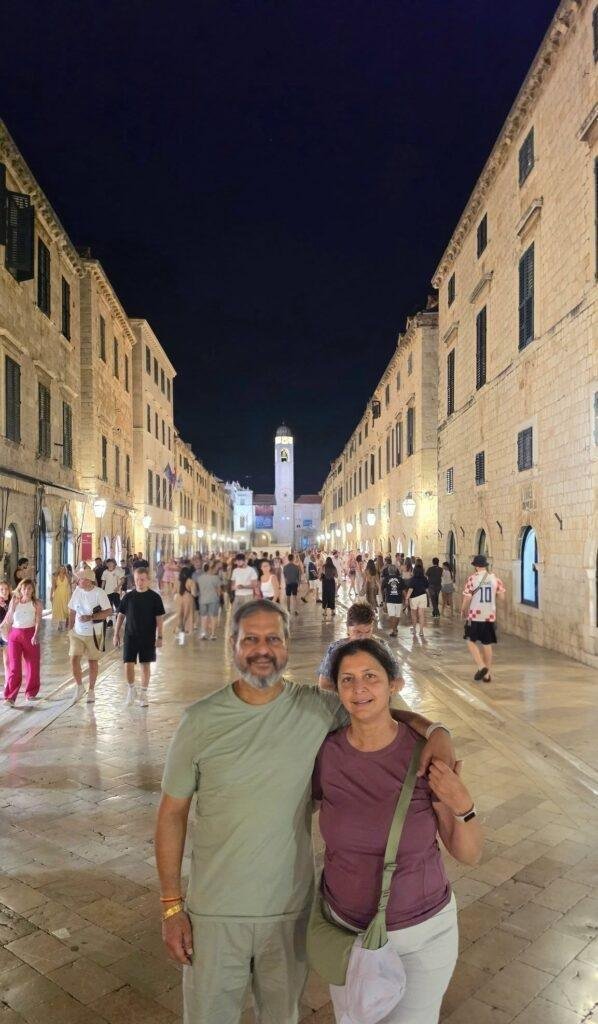
Stradun by night—the glowing limestone main street of Dubrovnik Old Town, still carrying the grandeur of medieval Dubrovnik.
This is the historic heart of the city: the Bell Tower, Sponza Palace, St. Blaise’s Church, Onofrio’s Fountain, the Franciscan Monastery and the Rector’s Palace are all in or just off this central axis.
We bought a three-day Dubrovnik Pass for €50 each—the price we paid during our visit. It covered the City Walls and several museums and made sense for our itinerary.
The Dubrovnik Pass pays for itself with a single walk on the City Walls while unlocking free access to top historical sites like Fort Lovrijenac and the Rector’s Palace. Plus, it includes free public transit, making it a hassle-free money saver that keeps your trip budget light and your sightseeing smooth.
Dinner was at Barba, a popular little seafood place. Honest verdict: it did not suit our palate. We are not accustomed to the strong seafood aroma or such lightly seasoned flavours, so the meal felt bland to us. Seafood lovers may disagree completely—food is personal!
Before returning to Villa Sigurata, we stocked up on water, bread, cheese and snacks at Konzum outside Ploče Gate. This was a small decision that saved both time and money.
Day 2 — Dubrovnik’s beauty, memory and island escape
We started at the Baroque Cathedral of the Assumption, then visited what appears from our notes to have been the Memorial Room of the Dubrovnik Defenders in Sponza Palace. Its photographs and names bring the 1991–92 siege of Dubrovnik out of the history books and down to a deeply human level.
Nearby, the morning market at Gundulić Square added colour and everyday life—fruit, vegetables and local produce beneath the surrounding stone buildings.
From the Old Port, we boarded the boat to Lokrum.

The island is a protected nature reserve just offshore, known for its wooded paths, botanical garden, peacocks, small saltwater lake popularly called the Dead Sea, Fort Royal and Benedictine heritage. Even the short boat ride changes the mood completely: one moment you are inside a busy walled city, the next you are looking back at it from the sea.
Lokrum also played Qarth in Game of Thrones. Inside the old Benedictine monastery complex, we found the Iron Throne photo spot.
Forget the armour. In the AI age, even the Iron Throne has a new dress code: shorts!
In the evening, we climbed to Fort Lovrijenac, also called St. Lawrence Fortress. The fort rises from a 37-metre rock outside Dubrovnik’s western wall and once guarded the city’s land and sea approaches. The stone inscription above its entrance captures the old Republic’s spirit: freedom was not to be sold for all the gold in the world.
Day 3 — Walking the roofline of Dubrovnik
No Dubrovnik visit is complete without walking its 1,940-metre City Walls—or, as I called them on Facebook, the “great” Walls of Dubrovnik because of the effort involved! We went early, before the stone became a giant frying pan.

The present circuit took shape from the 13th century and was repeatedly strengthened until the 17th century. Allow roughly 1½–3 hours, depending on your pace and how often you stop for photographs. The views include Lokrum, Fort Lovrijenac, the Old Harbour, Minčeta Tower, Bokar Fortress, terracotta roofs and the endless blue Adriatic.

Later we entered the Rector’s Palace, once the seat of government and the official residence of the rector of the Dubrovnik Republic. The Gothic-Renaissance palace also contained state offices, a courtroom, prison and armoury—proof that this was not merely a beautiful city, but a sophisticated maritime republic.
Day 4 — Dubrovnik to Kotor: the short drive that can take forever
On paper, Dubrovnik to Kotor is only about 90–93 kilometres and roughly two hours of driving. In summer, the Croatia–Montenegro border changes everything. We hit a long queue, so this became a genuine travel day.
The frustration disappeared once the road began tracing the Bay of Kotor. Mountains rise almost straight from the water, villages hug the shore and every bend seems designed for a photograph.
We checked into MonteBay Perla in Prčanj, had a late lunch at a Turkish restaurant on the waterfront, and spent the evening wandering inside Kotor’s walls. Kotor was an important medieval commercial and artistic centre, and its fortified town sits inside a UNESCO-listed cultural landscape where stone settlements and steep mountains seem inseparable.
Day 5 — Kotor Fortress before breakfast, then Montenegro’s wild interior

The alarm went off at 5:30 a.m. We left the hotel at 6:20, reached Kotor in about ten minutes and parked at Benovo parking for €2 per hour—our 2026 price.
We entered by Entrance A near St. Mary’s Collegiate and began the climb to San Giovanni, or St. John’s Fortress. The standard route climbs roughly 260 metres through around 1,350 stone steps. Rated “moderate”—but your legs may strongly disagree!
We reached the fortress at 7:35 a.m., with my heart rate hovering around 135. This is the real Kotor victory shot: the UNESCO-listed Old Town below, the two linked bays opening toward the Adriatic and mountains rising almost directly from the water. Starting early made all the difference: cooler stone, softer light and far fewer people.
After a good breakfast back at MonteBay Perla, we set off toward Lipa Cave using the mountain route.
Hairpin bends, narrow cliff-edge roads and a new postcard view every few minutes—this is why you do not rush through Montenegro.
The Kotor Serpentine delivered huge views over the bay and Adriatic—but also 25 hairpins, narrow sections and moments when the road felt barely wide enough for one car.

The most astonishing part is not how beautiful the cave formations are—it is that nature created them, one drop at a time.
Lipa Cave’s official site describes a 2.5-kilometre system of passages and halls, carved by water over roughly six million years. The visitor experience begins with a small train ride before passing stalactites, stalagmites, columns and curtain-like formations. The cave stays around 10°C, even when the summer heat outside is intense. Carry a jacket.

We stopped in Nikšić for lunch and then continued through Montenegro’s increasingly dramatic interior, reaching Hotel SKI in Žabljak at 7:20 p.m.
Day 6 — Black Lake, Tara Canyon and 20,000 steps
Žabljak sits at the gateway to Durmitor National Park, a landscape shaped by glaciers, rivers, underground streams and high limestone peaks.
We hiked around Black Lake—Crno Jezero, one of Durmitor’s glacial “mountain eyes,” at roughly 1,416 metres above sea level. It is actually formed by two interconnected lakes beneath the Durmitor Massif.

The loop is approximately 3.6 kilometres, but staying close to the water can turn a pleasant walk into a much tougher hike: parts of the lower shoreline path are rooty, rocky and more demanding than the broader upper trail. By the time we also explored the Tara Canyon area, the counter showed roughly 20,000 steps.
Dinner was at Restaurant Podgora: chicken fillet with blue-cheese sauce and roast pork. Then came our nightly travel ritual—the FIFA World Cup. England came from behind to beat DR Congo 2–1.
Day 7 — Rafting the Tara
This was our full-adventure day: rafting the Tara River through the Durmitor region.
A canyon deeper than anything else in Europe—and the only way to truly feel it is from the river.

UNESCO identifies the Tara as Europe’s deepest gorge. Statistics fade quickly once you are in the raft—clear turquoise water below, cold spray in your face, forests and cliffs above, and fast water doing its best to remind you who is in charge.
We returned for another early dinner at Podgora, followed by France’s 3–0 win over Sweden. By this stage, our trip had developed a perfect rhythm: mountains by day, football by night.
Day 8 — Žabljak to Sarajevo via Piva Lake
The road from Žabljak toward Piva Lake and Plužine is one of the most spectacular drives of the trip. Hairpins, narrow cliff-edge roads and a new postcard view every few minutes make distance almost meaningless here.
Piva’s turquoise water looks natural, but it is actually a reservoir created by the Mratinje Dam. The road repeatedly disappears into rough, unlit tunnels carved through solid rock, then bursts back into daylight above the water.
We stopped at viewpoints and walked through some of the tunnels before continuing through the Šćepan Polje/Hum border area toward Sarajevo. This is a slow mountain route, not a road on which to chase a navigation app’s arrival time. With viewpoints, border formalities and breaks, allow most of the day.
We reached Hotel Aziza around 7:15 p.m., walked through Sarajevo’s Ottoman-era old quarter and joined hundreds of locals and travellers at the public Fan Zone. Watching Spain’s 3–0 win over Austria on the giant screen, surrounded by passionate supporters, became an experience in itself.
Day 9 — An Olympic track, a wrong turn and an ATV ride to Lukomir
We drove up Mount Trebević to the 1984 Olympic bobsleigh and luge track.
Imagine hurtling down this track at racing speed—we were perfectly happy just walking through it!
It once hosted Sarajevo’s Winter Games, was later damaged during the siege, and now winds through the forest under layers of graffiti and street art—a striking mixture of Olympic history, wartime scars and modern creativity.
Our plan was simple: walk up the T1 trail and descend along the track. Naturally, we lost the way, climbed again, found T1 and finally reached the right route. We took graffiti pictures, filmed running clips and even kicked pine cones down the track like footballs. Not every travel memory needs a monument—sometimes a wrong turn creates the best videos.
Then we drove from Sarajevo to Konjic for our 2:30 p.m. quad tour.
You don’t visit Lukomir. You earn it.
Our total excursion lasted about five hours; the ATV run from Konjic to Lukomir took roughly 90 minutes. With our guide Hares, we climbed through rocky tracks, alpine meadows, dramatic ridges and wide mountain viewpoints to Lukomir, at about 1,495 metres on Bjelašnica.
Lukomir is one of Bosnia & Herzegovina’s highest and most isolated traditional mountain villages. Its stone walls, traditional roofs, sheep-farming culture and surrounding stećak tombstones preserve a way of life rarely encountered on a normal road trip. From the village, we walked higher for views toward the deep Rakitnica Canyon, between the Bjelašnica and Visočica ranges.
Dinner in Lukomir—lamb, chicken fillet and spinach pie—felt like the perfect reward. Stone houses, mountain air and warm Bosnian hospitality made this one of the trip’s standout experiences.
The night still had one twist left: Australia and Egypt finished 1–1, before Egypt won the penalty shootout 4–2.
Day 10 — Tito’s secret beneath the mountain
Back to Konjic—this time for one of the strangest museums we have ever visited.
If these walls could talk, they would tell one of the Cold War’s greatest secrets.

ARK D-0, better known as Tito’s Bunker, was built in complete secrecy beneath Mount Zlatar between 1953 and 1979—26 years spent creating what feels like a secret city inside a mountain. According to both our official tour guide and the bunker’s official history, its construction cost the equivalent of US$4.6 billion at the time. The official history describes it as the third-largest investment of former Yugoslavia.
Its protected interior covers about 6,500 square metres, divided into 12 connected blocks. It was designed to shelter Yugoslavia’s military and political leadership—around 350 people—for up to six months after an atomic attack.
The entrance hides behind an ordinary-looking building. Inside are command rooms, living quarters, a water-filtration system, diesel storage tanks, telex communications and other equipment preserved like a Cold War time capsule. The bunker later became a venue for contemporary art, adding an unexpected new layer to its history.
After the tour, we slowed down beside the Neretva: Konjic’s old stone bridge, a riverside café and a walk through the centre. Back in Sarajevo, the sauna helped after days of climbing—and then we joined the Fan Zone as Morocco ended Canada’s run with a 3–0 win.
Day 11 — Sarajevo to Mostar: sleeping inside history
The drive from Sarajevo to Mostar follows the Neretva corridor and normally needs about two to two-and-a-half hours. We checked into the remarkable Muslibegović House, an 18th-century Ottoman residential complex that is both a national monument, museum and hotel.
From there we walked to Stari Most, the Old Bridge, and the lanes of the old bazaar. The original Ottoman stone bridge was completed in 1566, destroyed in 1993 and reconstructed in 2004. Today, UNESCO describes the rebuilt bridge and Old City as symbols of reconciliation and coexistence.
At night, Mostar’s stone streets soften under warm lights and the bridge seems to float above the dark Neretva. It is one of those places that feels completely different after the day tours leave.
Day 12 — Minaret views, Počitelj heights and back to the Adriatic
At 10:00 a.m., we toured the museum section of Muslibegović House, learning how a prominent Mostar family lived within its courtyards, carved wood interiors and separate private spaces.
At 11:00, we visited the Koski Mehmed Pasha Mosque, completed in 1618. We climbed the narrow minaret staircase for one of Mostar’s best panoramas: the Old Bridge, the Neretva and the layered rooftops of the city.
We could leave only around noon, so our final Bosnian stop was Počitelj, about 30 kilometres south of Mostar.
No… I’m not about to bungee jump! 😳😂
We climbed through the steep stone lanes and different levels of Počitelj Fort, a strategic complex overlooking the Neretva corridor and the historic route between the Adriatic and Bosnia’s interior. The fortified town is traditionally attributed to Bosnian King Stjepan Tvrtko I in 1383, but the first surviving documentary references date from 1444. Its medieval nucleus was expanded repeatedly, especially under Ottoman rule.
From the upper fortifications, the village falls away toward the Neretva in a stone amphitheatre. Every uphill step felt worthwhile—although sitting close to that ledge certainly got the heart racing.
The domed building below is the historic Šišman Ibrahim Pasha Mosque, also known as Hadži Alija Mosque, built in 1562–63. Počitelj is on UNESCO’s Tentative List—not yet the World Heritage List—and its importance lies in the way medieval fortifications and Ottoman urban architecture survive together.
After the climb, we crossed back into Croatia and reached Hotel Villas Plat at 6:30 p.m. Plat is a coastal village between Dubrovnik and Cavtat; the hotel is not in Cavtat proper. We ended the evening with a walk along the pebble beach and one more World Cup match beside the Adriatic.
Day 13 — One last breakfast by the sea
Our final morning was deliberately slow: breakfast at a waterfront restaurant, the Adriatic almost at our feet, and a friendly Nepalese team serving us far from both Nepal and Canada. It was an unexpectedly familiar South Asian connection at the end of a very European road trip.
From Hotel Villas Plat, Dubrovnik Airport is only about 9 kilometres or 10–15 minutes by car. We returned the rental car and caught our 11:35 a.m. flight home—tired, happy and carrying far too many videos.
Realistic driving times for this route
These are planning ranges, not promises. Border queues, summer traffic, roadworks, weather and photo stops can change the day dramatically.
| Route | Normal moving time | What to allow in real life |
| Dubrovnik → Kotor | 1 hr 45 min–2 hr | 3–5 hr in summer; border can add hours |
| Kotor → Lipa Cave via scenic mountain road | 1–1.5 hr | 2+ hr with serpentines and viewpoints |
| Lipa Cave → Nikšić → Žabljak | 2.5–3 hr | 4+ hr with lunch and stops |
| Žabljak → Piva/Plužine → Sarajevo | About 5–6 hr | 7–9 hr with border, tunnels and viewpoints |
| Sarajevo → Konjic | About 50–70 min | 1–1.5 hr with city traffic |
| Sarajevo → Mostar | About 2–2.5 hr | 2.5–3 hr with breaks/traffic |
| Mostar → Počitelj | About 30 min | 35–45 min leaving the city |
| Počitelj → Plat | About 2–3 hr, route-dependent | Add border time and do not set a tight check-in |
| Hotel Villas Plat → Dubrovnik Airport | 10–15 min | Allow rental return and airport formalities separately |
What to know before driving this Balkan route
- Treat border time as unknown. Croatia is in the EU/Schengen area; Montenegro and Bosnia & Herzegovina are not. The Karasovići–Debeli Brijeg crossing can be extremely slow in summer. Check the official HAK camera before leaving and carry water.
- Get written rental-car permission. Tell the rental company in advance that the car will enter Montenegro and Bosnia & Herzegovina. Ask exactly which authorization and insurance documents it requires; company rules vary.
- Do not trust distance alone. Ninety kilometres on a Balkan mountain road can take longer than twice that distance on a motorway.
- The Kotor Serpentine is not for nervous drivers. It is paved but narrow, with tight hairpins and limited passing space. Avoid it in darkness and do not rush.
- Piva and Durmitor roads are seasonal mountain roads. Check conditions locally, especially outside high summer. Expect narrow sections, livestock, cyclists and unlit rock tunnels.
- Start the Kotor and Dubrovnik climbs early. Carry water and wear shoes with grip; polished stone becomes slippery.
- Know the currencies. Croatia and Montenegro use the euro. Bosnia & Herzegovina uses the convertible mark (BAM/KM). Keep some cash for parking, small cafés and rural stops.
- Download offline maps. Mobile roaming rules and coverage change after each border, and mountain signals can disappear.
- Plan fuel and daylight. Fill up before the remote Žabljak–Piva–Hum route and avoid beginning unfamiliar mountain sections late.
- Leave room for the unplanned. Our best moments included a wrong trail, pine-cone football, an unexpected Nepalese connection and long stops simply looking at the mountains.
Final verdict
Dubrovnik gave us beauty. Kotor gave us drama. Durmitor gave us adventure. Sarajevo gave us layers of history and life. Lukomir gave us a journey we had to earn. Konjic took us inside the Cold War, while Mostar and Počitelj showed how stone can carry both memory and hope.
If you want one Balkan trip that combines coast, mountains, history, culture, food and genuine adventure, this route delivers all of it.
Just leave early for the border.